
Intelligent learning personalization

In education, diversity is a wealth… but also a challenge. Each person arrives at training with different levels of knowledge, interests, learning paces, and needs. How can we ensure everyone learns effectively, without creating a different classroom for each case? The key is knowing when to be together and when not.
Beyond the discourse: real and achievable personalization
Much is said today about artificial intelligence and learning personalization. From an advertising standpoint, these promises sound spectacular… but often they’re just that: promises.
The good news is that, beyond the discourse, we already have concrete tools that allow us to advance effectively—and without titanic efforts—along that path. One of them is Selective Reach, a tool available on our platform for a long time.
What is “Selective Reach”?
Yes, we know the name sounds technical and hard to remember. However, its function is very simple and powerful: this tool allows you to assign specific content only to those who need it, while keeping the entire group in the same learning space.
It’s like a community library, where each student accesses the books they need according to their level, objectives, or interests. This way, everyone shares space and experiences, but receives personalized attention.
Where does the difficulty lie? As always in pedagogical work, in planning actions, defining which content is common and which isn’t, what remedial strategies will be used if necessary, or what different elements are needed. Once these matters are defined, the setup is very simple.
It is possible to assign content from texts, study materials, activities, assessments, forms linked to each unit or class within the Program section.
Personalization without fragmentation
Peer learning is fundamental: debates, group work, idea exchange, common classes and materials… All of that strengthens the learning experience. But there are also moments when each student needs something specific:
- Those who master a topic can access advanced challenges, which may be new classes, differentiated materials, or even assessments.
- Those who haven’t reached the objectives can receive reinforcement activities.
- In interdisciplinary spaces, common content can be shared with differentiations by disciplinary areas when required.
- It’s possible to offer bibliography adapted by difficulty level or by personal interests.
- Students who require extra support receive it without that being visible to others.
- And everything each teacher deems necessary to personalize.
Advantages of an integrated approach

Group cohesion: Everyone feels they are part of the same course, avoiding fragmentation.
Pedagogical flexibility: Teachers and tutors adapt content according to real needs, without duplicating spaces or efforts.
Operational efficiency: One course, multiple pathways. Like an orchestra where each musician has their own sheet music, but everyone performs the same symphony.
Manual selection: Ideal for small groups or when it’s clear who needs what.
Bulk upload: Perfect for large cohorts; allows assigning content to up to 500 users through a file.
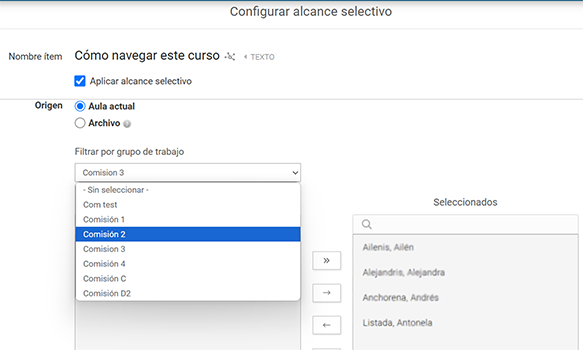
Selective Reach is a versatile and very useful tool. It represents a balance between individual attention and shared experience. It makes learning personalization a reality—beyond the discourse—in an efficient, effective way, and focused on what truly matters: each student’s learning.